Pursuing a PhD in Australia without going broke is still possible. International students have access to over 1,000 scholarships in Australia, ranking it amongst the most generous nations in the world when it comes to funding PhD studies. There are countless generous scholarships to fund your studies from the government-sponsored Research Training Programme (RTP) which provides scholarships worth 42,000 AUD per year to university research scholarships.
Identifying and attaining the PhD funding they need requires careful planning to understand the underlying available opportunities and corresponding application requirements. This guide is aimed to serve both resident students and students from abroad, detailing in breadth every available funding strategy, along with the chances for positive outcomes.
A Survey of the PhD Funding Situation in Australia
The General Situation
There are over 1,000 scholarships for Australian students for the year 2025-2026, with an average monthly stipend of 20,000 AUD available to all active PhD scholars enrolled in leading Australian universities. The scholarships typically also cover tuition fees, accommodation, health insurance, and a travel allowance.
The annual compensation of USD 36,000 to USD 42,000, available for doctoral students, has been escalating for a number of years. Alongside grants, students receive research stipends, health insurance, and tuition assistance. Consequently, Australia becomes one of the appealing options for funded doctoral research anywhere in the world.
The Various Types of PhD Funding Available
Governmental Allocated Scholarships
- Australia Awards Scholarships
- Research Training Programme (RTP) Scholarships
- Destination Australia Programme (DAP)
University Allocated Scholarships
- ANU PhD Scholarships
- Focused research grants
- Melbourne Research Scholarship
- UQ Graduate School Scholarships (UQGSS)
External and Industry Origin
- Industry partnership scholarships
- Funding from international organisations
- Research council grants
The backbone of financial support for PhD students in Australia comes from the Research Training Programme (RTP) scholarships.
RTP Programme: An Overview
The RTP programme is one of the essential parts of funding for PhDs in Australia, alongside the RTP scholarships provided by the Australian Government and distributed through multiple universities.
RTP Financial Benefits for 2025
Awarded to PhD students by the government of Australia, this scholarship is set to be worth A$40,000--A$42,000 (2025 rate). These amounts are inclusive of tuition fees and the stipend. The RTP package usually constitutes:
- Living stipend: AUD 31,000-42,000 per annum (tax free)
- Tuition fee offset: Full remission of fees for the research degree(s)
- Overseas Student Health Cover: For students of foreign nationality
- Research support: Up to AUD 2,000 for research thesis-related expenses
- Period: 3.5 years for PhD, 2 years for Masters by Research
RTP Eligibility Requirements
Academic Requirements
- First class honours degree or its equivalent
- GPA of 3.5/4.0 (or its equivalent)
- Proven academic performance in the discipline
- For international applicants, demonstrate that they fulfil the English language requirements
Residency Requirements
- To Australian and International students
- Citizenship limitations for a number of universities is nonexistent
- Appropriate visa arrangements are required for international applicants
Research Requirements
- Accepted into or enrolled in the HDR programme
- Proven research supervisor and relevant research outline
- Ability to demonstrate research and innovation
Step-by-Step Guide: How to Apply for PhD Funding in Australia
Phase 1: Research and Preparation (6-12 months in advance)
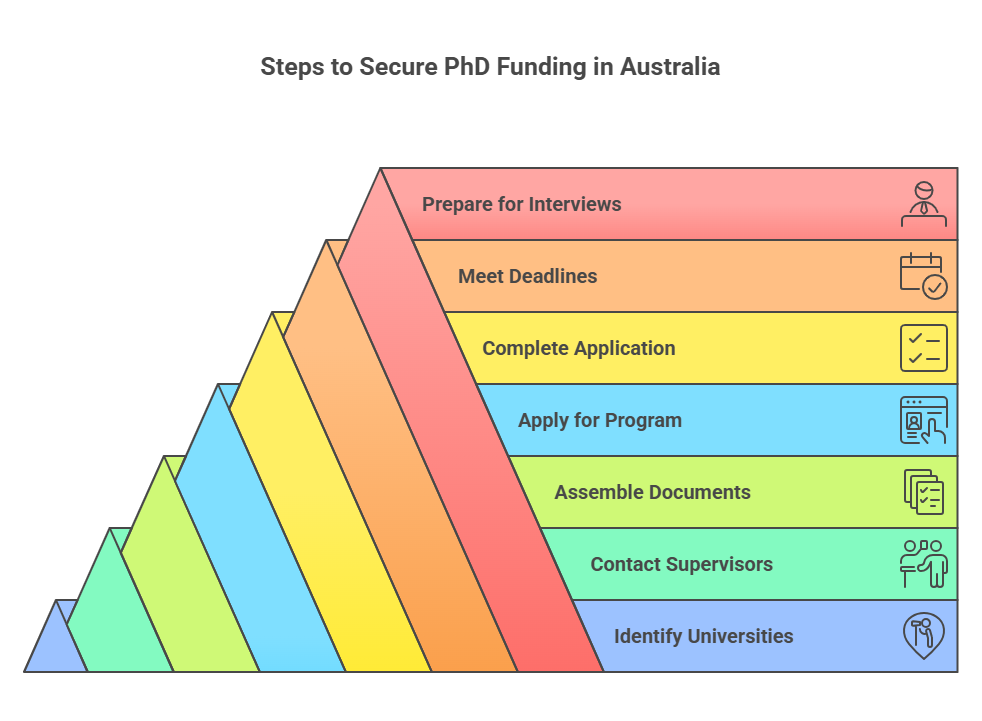
Step 1: Identify Your Target Universities
Target the universities that have favourable financing opportunities for the type of research you are intending to do.
The following universities are highly ranked for RTP scholarships:
- The University of Melbourne
- Australian National University (ANU)
- The University of Queensland (UQ)
- The University of Sydney
- The University of Adelaide
Step 2: Get in touch with potential supervisors
It is suggested to make contact between 6 to 12 months before the expected starting date. A willing supervisor can improve the chances of getting funding enormously by:
- Writing supportive letters
- Knowing possible sources of funding
- Improve your research proposal
Step 3: Assemble Required Documents
Most applications will include:
- Certified copies of academic transcripts (and translated versions)
- Research proposal (2000 to 4000 words)
- CV emphasising research
- English proficiency assessment results (IELTS/TOEFL)
- 2 to 3 recommendation letters
- Documents indicating research activities
Phase 2: Application Submission (3 to 6 months prior)
Step 4: HDR Programme Application
This scholarship is accessible when applying for a PhD or MPhil. You do not have to apply for a scholarship separately. Many institutions offer HDR scholarships as part of the admission package.
Step 5: Completing Components of Scholarship Application
On your HDR application, make sure to:
- Select areas of the application to be considered for scholarship awards
- Prepare a research proposal of considerable depth
- Describe any pertinent research performed
- Obtain persuasive recommendation letters
Step 6: Fulfil Submission Dates
Submission dates differ between universities.
- Key periods: Generally March to May for the first half of the year intake, and August to October for the following year's intake
- For instance, Deakin University has opened applications for candidates whose courses commence between May 1 and October 27, 2025
Phase 3: Post-Submission Period (1 to 3 months)
Step 7: Preparing for Interviews
Some universities will invite candidates of interest for an interview. Prepare for:
- Defend your research proposal
- Describe your methodology and propose a timeline
- Discuss your career and its motivating factors
- Outline your intended contributions to the university
University-Specific Scholarship Opportunities
University of Melbourne
International and domestic students enrolled in a graduate research degree at the University of Melbourne can apply for the Melbourne Research Scholarship and Research Training Programme (RTP) Scholarship.
Benefits:
- AUD 31,200+ annual stipend
- Tuition fee at 100% reimbursement rate
- Health Insurance Coverage for overseas students
- Interstate/international students are eligible for relocation reimbursement
University of Queensland (UQ)
At University of Queensland (UQ), you can choose from 2 primary PhD scholarship categories: UQ Graduate School scholarships (UQGSS) - $36,400 per year for 3.5 years, tax free (as of 2025) - open to both local and overseas students.
Australian National University (ANU)
ANU PhD scholarship- This is a stipend scholarship awarded by ANU Colleges to candidates pursuing Higher Degree by Research.
Unique Features:
- More flexible study arrangements
- Strong industry partnerships
- Excellence in Research support
- Collaborations with foreign research primarily involved
Australia Awards (Students of foreign countries who desire to study abroad)
Programme Overview
Australia Awards Scholarships are long-term awards dealt with by the Department of Foreign Affairs and Trade. Developing countries are the primary focus of these scholarships, providing tailored assistance to PhD students.
Coverage Includes:
- Full Tuition Fees
- Establishment Allowance
- Living stipend
- Travel allowances
- Health insurance
Eligible Countries:
- Southeast Asian nations
- Countries in the Pacific Islands
- Countries in Africa
- Some nations in Latin America
Additional Funding Options and Strategies
Destination Australia Programme (DAP)
The Australian Government sponsors the Destination Australia Programme (DAP) which is worth up to AUD $15,000 per student every academic year. As a PhD student, you're entitled to these scholarships for a maximum of four years.
Industry Partnership Opportunities
Academic institutions have in collaboration with industry, more sponsorship positions offered for the PhD, such as:
- Improved stipends ranging from $45,000 to more than 60,000 Australian dollars
- Development for professional skills
- Pathways with guaranteed employability
- Access to industry resource and networking
Professor Michael Thompson, Graduate Research Director "In our experience, successful applicants have the most level research vision, along with supporting strong academic foundations to the field. Students who are able to articulate their goals and demonstrate thoughtful consideration toward their research endeavour have the highest probability of receiving funding."
Common Challenges and Their Solutions
Challenge 1: Selection Process
- Apply to many universities and programmes
- Gain research experience to enhance your application
- Establish strong connections with future mentors
Challenge 2: English Language Proficiency
- Allocate 6-12 months towards learning English in advance
- Enrol in English programmes offered by the targeted university
- Take the tests more than once the IELTS/TOEFL
Challenge 3: Creating a Proposal
- Communicate with possible advisors who will guide you
- Study successful proposals within your specialisation
- Enrol in Proposal Writing Classes
Your Next Steps: Action Planning
Immediate Actions (This Week)
- Research Target Universities: Compile 5-10 universities of interest to your research area
- Document Preparation: Start filing academic certificates and transcripts
- English Proficiency Exams: Enrol in IELTS or TOEFL if needed
Short-term Goals (Next 3 Months)
- Supervisor Contact: Contact 2-3 possible supervisors for each university
- Research Proposal: Start working on your research proposal
- Application Strategy: Plan schedule for several applications
Long-term Strategy (Next 12 Months)
- Submit Applications: Fill applications for a number of institutes
- Interview Preparation: Get ready for possible interviews and tests
- Backup Planning: Other funding sources and different universities
Conclusion
Obtaining funding for a PhD in Australia requires careful planning, attention to detail, and continued effort. There are lots of fully funded scholarships and government initiatives, such as RTP, that make these opportunities meaningful for individuals who would qualify.
Focus on starting early, casting a wide net, and refining your research candidate profile to present yourself as a polished candidate. With the right funding strategy, you can cover the entirety of your Australian PhD expenses.
Frequently Asked Questions
Q: At what stage should I start the process of securing funds to pursue a PhD in Australia?
A: Ideally, the entire process should be commenced 12-18 months before your intended start date to allow ample time to reach out to a supervisor, gather the necessary documents, and submit the application.
Q: Are international students eligible to the same funding as domestic students?
A: Yes, the majority of flagship scholarships such as RTP are open to both domestic and international students. Some scholarships such as the Australia Awards are specifically designed for international students.
Q: How crucial is it to have a supervisor before applying?
A: Quite crucial. The presence of a supervisor guaranteeing your sponsorship greatly increases your chances of funding and admission success.
Q: Is it possible to undertake paid employment during a PhD scholarship in Australia?
A: Most scholarships offer the opportunity to undertake paid work (typically around 8 hours a week). Please check the individual scholarship you are applying for, as this varies across programmes.
Testimonial
Dr. Sarah Chen, PhD from the University of Queensland "I passed all the tests and obtained full RTP financing for my doctorate in environmental sciences at the University of Queensland. The key to all of this, from my standpoint, was to reach out to the corresponding supervisor at least 18 months."