The Bridge Course Revolution
The time between completing secondary school and university is crucial for many students. They fail to realise the academic gaps which will create huge problems for their post-secondary education. Bridge courses have the potential to transform untold academic struggles into success stories.
Close to 70 percent of graduates of bridge programmes achieve a 3.0 or better for the next degree attested by the American Council of Education (2023). That is much better than the 41 percent of university students who do not experience any preparatory assistance.
What is a Bridge Course?
These courses facilitate students who are coming into the main programmes with some set of skills and knowledge by helping them acquire crucial skills and knowledge. Such skills and knowledge gaps are the primary reason for a student's inability to accomplish a target degree and, therefore, these preparatory courses function as academic wings.
Bridge programmes focus on more than just remediation by:
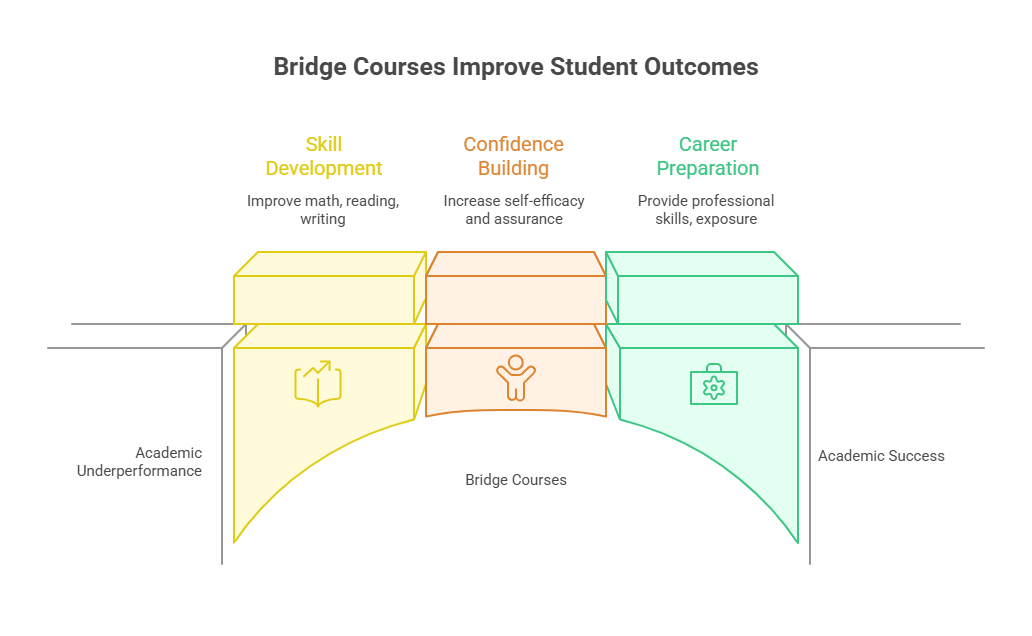
- Enhancing core skills: Mathematics, science, English, and critical thinking skills
- Developing study tactics: Time management, efficient note-taking, and effective research
- Building self-assurance: Facilitating success to promote self-efficacy
- Initiating engagement with university culture: Warm, student-centred orientation to university
The Evolution of Bridge Education
The 1970s saw the emergence of the current framework of bridge courses. These bridge editions saw students as learners who needed skills, and worked on:
- Competency-based learning: Advancement is determined by skills, rather than the time taken to complete tasks
- Technology integration: Learning is improved by the use of digital tools, and progress is monitored and assessed
- Individualised approaches: Tailored programmes designed for each learner
- Industry integration: Academic learning is linked to practical work
The evolution of bridge courses have allowed them to shed the negative stereotype of "remedial" programmes, to flattering titles of elite preparatory courses.
The Game-Changing Benefits of Bridge Courses
Academic Performance Enhancement
Students completing supported bridging programmes show improvements in different academic fields:
Grade Point Average Improvements:
- Bridge course graduates from all programmes have GPAs of 3.0 and above at the rate of 73 percent
- Direct entry students' GPAs in first year increased by average of 0.8 points
- First year course failures reduced by 45 percent
- 67 percent of the students are able to graduate from the programme in the time expected
Skill Development Outcomes:
- Their average mathematical competency scores increased by 35 percent
- Their reading comprehension improves by 2 to 3 grades
- Their reasoning scientifically improves by 40 percent
- Their academic writing improves by 28 percent
Confidence and Self-Efficacy Building
The most important and lasting impact of the bridge courses is the change in the students' self-perceptions:
The Community College Research Centre has demonstrated that students who participate in bridge programmes have:
- 82 percent report a positive change in their academic self-confidence
- 76 percent report that they have a better understanding of themselves as learners
- 69 percent are more self-assured in being able to solve problems
- 71 percent are able to communicate more self-assuredly
Career Preparation Integration
Bridge programmes nowadays have an added advantage of providing students with professional skills:
- Industry exposure through guest speakers and field visits
- Professional skills in communication, teamwork, and leadership
- Career exploration: Assisting students in matching their educational pathways to potential professions
Step-by-Step Guide: How Bridge Courses Work
Phase 1: Evaluation and Placement (Week 1-Week 2)
Step 1: In-depth Skills Evaluation
All bridge programmes begin with a comprehensive and broad analysis:
- Assessment of academic readiness: mathematics, reading, writing and science
- Evaluation of learning styles: visual, auditory, or kinaesthetic
- Setting goal: defining programmes and professions to pursue
- Assessment of support needed: academic, personal, or financial assistance
Assessment methods include:
- ACCUPLACER College Placement Test
- TABE (Test of Adult Basic Education)
- Custom institutional assessments
- Portfolios for creative programmes
Step 2: Tailor-made Learning Plan Drafting
Based on the assessments, plans include:
- Skill gap analysis: areas of weakness
- Learning goals: targets for each subject
- Schedule: reasonable time frames for learning
- Referral: tutoring, counselling, and tech support
Phase 2: Focused Skill Development (Week 3-Week 12)
Step 3: Mastery of the Basic Subjects
Students receive instruction in the following core areas:
Mathematics:
- Introductory pre-algebra and algebra
- Basic geometry and trigonometry
- Introductory statistics and data analysis
- Problem-solving and basic logical reasoning
English and Communication:
- Mastery of grammar and sentence construction
- Basic academic writing
- The development of reading comprehension skills
- The development of skills needed for oral presentations
Science Foundation Track:
- The understanding of the scientific method
- Developing basic skills in the laboratory
- Gathering and analysing data
- Application of critical thinking in science
Step 4: Study Skills and Learning Strategies
Thorough training in achieving academic success:
- Time management --- how to formulate optimal study plans
- Note-taking --- the Cornell system, outlining, and mapping
- Strategies for taking various types of exams --- multiple choice, essays, and practical exams
- Developing research skills: How to locate a library, evaluate its sources, and cite material
Step 5: Advancing the Proficiency of Developed Skills
The development and integration of basic digital skills:
- Learning management systems such as Canvas, Blackboard, and Moodle
- Microsoft Office: Word, Excel, and PowerPoint
- Learning to use research databases: Information on the Internet such as professional online repositories and Google Scholar
- Using online tools for collaboration: Google Workspace, Zoom, and other project management tools
Phase 3: Integration and Transition (Weeks 13-16)
Step 6: Application and Practice
Acquired skills are used in the:
- Capstone projects that showcase curricularly integrated learning
- Peer collaboration that incorporates group work within a university context
- Presenting that focuses on the consolidation of knowledge for confidence development
- Simulated experiences of a university, where students are given lectures and seminars
Step 7: Preparation for the Transition to University
Final preparation involves:
- Support for students in selecting and planning their classes
- Familiarising students with university resources
- Academic planning support with goal setting
- Connection with mentorship and tutoring
Conclusion
Bridge courses prepare students not just academically, but also physically and emotionally. Students that partake in such programmes are more likely to exceed expectations, outperform their colleagues and perform better.
This Week:
- Investigate local schools for available bridging programmes
- Use online self-assessment tools to evaluate your skills
- Call the admissions staff about programme alternatives
This Month:
- Book assessments at desired schools
- Complete applications for available monetary support
- Reach out to current or recent bridge course students
Remember, opting for a bridge course is not an indication that you have failed, but a mark of sound thinking, understanding, and commitment to your future success. The initial effort needed for bridge work has eternal benefits that span across your academic and professional life.
Frequently Asked Questions
Q: Are bridge courses considered "remedial" and will they appear negatively on my transcript?
A: Most modern bridge courses are considered preparatory and not remedial. Many institutions will classify them as "developmental" or "preparatory" courses. Some programmes serve as non-credit intensive courses and are not recorded on the student's official transcript.
Q: How long do bridge programmes typically take to complete?
A: The duration varies depending on individual needs:
- 6 to 10 weeks for intensive summer programmes
- 12 to 16 weeks for semester long programmes
- 2 to 3 semesters for comprehensive programmes
- Self-paced online programmes typically take 3 to 12 months
Q: Does completing a bridge course guarantee admission to my target degree programme?
A: Completing a bridge course enhances admission opportunities, however, it does not guarantee acceptance. Some institutions provide bridge-to-degree pathways where completing the bridge course guarantees admission to specified programmes.
Q: Is it possible to receive financial aid for bridge courses?
A: The answer is programme-dependent:
- Credit-bearing bridge courses are eligible for federal financial aid
- Non-credit programmes might have institutional aid
- Many community colleges offer low-cost bridge programmes
- Work-study and payment plan options are commonly available
Testimonials
Dr. Sarah Johnson, Educational Psychology Professor:
"One of the marvels of educational outstanding is the introduction of bridge courses. These courses ensure that the student's starting point doesn't limit their potential. Bridge programmes graduates usually outperform their peers because they possess more effective learning methods and greater tenacity."
Jennifer Martinez, Academic Success Director:
"It's like watching a caterpillar become a butterfly. These students come with a lot of self-doubt and set low expectations. I have now seen them turn into leaders that engage in debates, solve tricky issues, and offer encouragement to their peers."