Finishing the Secondary Education Examination (SEE) is a proud moment in every Nepali student's journey. Yet, the wait from results day to grade 11 enrolment can feel heavy with unanswered questions.
Do you need to enrol in a bridge course? Which academic stream suits your goals? How much will it cost? Feeling this way is part of the process, and you're in good company.
Bridge courses have grown in popularity for SEE graduates because they offer a clear, supportive way to transition to higher secondary education. Last year alone, more than 48,000 students took advantage of these programmes at top institutions.
What's a Bridge Course After SEE?
A Bridge Course is a tailored programme that helps you move smoothly from secondary to higher secondary education. In Nepal, after you finish your SEE class 10, you might choose one of these courses to get ready for class 11. Instead of simply revising past syllabi, the Bridge Course fine-tunes the important subjects, skills, and mind-sets you'll need for your next level.
The course also sharpens your test-taking skills and builds your confidence. It zeroes in on the most common admission test questions from the most respected colleges and higher secondary schools, whilst also giving you practical sample questions and structured, timed quizzes.
Main Goals of a Bridge Course
1. Academic Base: You will cover the fundamentals of the grade 11 and 12 curricula, regardless of your intended stream in science, business, or humanities.
2. Entrance Test Preparation: If you want to enrol in top colleges such as St. Xavier's, Prasadi, KMC, NIST, or United Academy, you will need to sit for their specific entrance examinations.
3. Career Exploration: These programmes empower students to investigate distinct academic pathways without immediate specialisation, offering exposure to varied disciplines and professional routes.
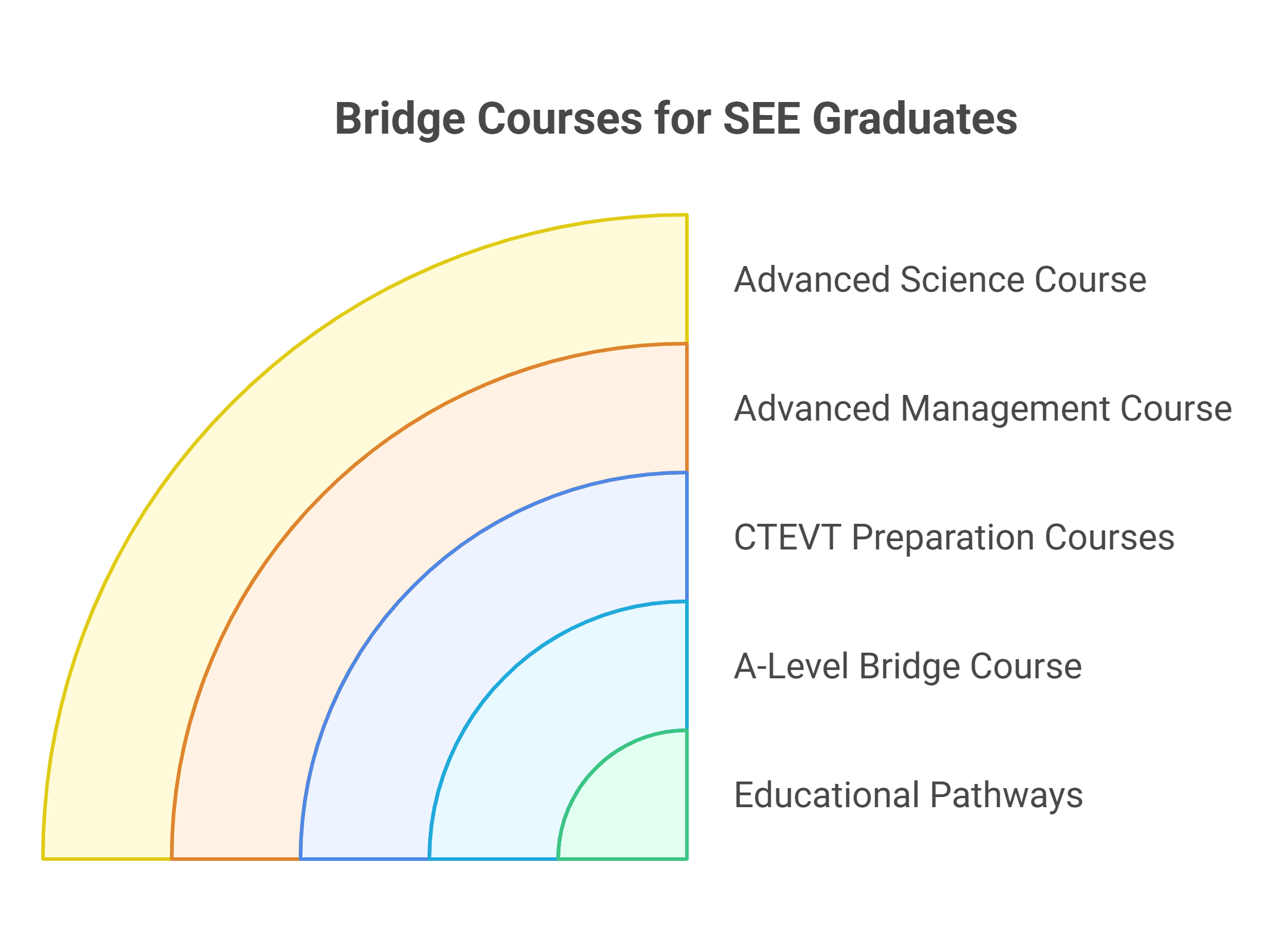
Types of Bridge Courses Available
SEE graduates can select from tailored bridge programmes aligned with their future goals:
Advanced Science Course
This course caters to SEE completers aiming for degrees in science and technology. The curriculum reinforces:
- Fundamentals of physics and analytical problem-solving
- Chemistry principles coupled with hands-on laboratory experience
- Core biology for future medical studies
- Advanced mathematics tailored for engineering foundations
Advanced Management Course
This offering is orientated toward SEE graduates targeting business and management studies. Key subjects include:
- Foundational accounting and basic financial literacy
- Principles of economics and introductory market analysis
- Business mathematics with real-world applications
- English proficiency for effective communication in business contexts
A-Level Bridge Course
This programme is crafted for motivated SEE students awaiting their results who intend to proceed to Cambridge A-Levels. It provides a smooth transition to internationally recognised qualifications.
CTEVT Preparation Courses
If you're considering a future in technical education, targeted programmes get you ready for:
- Health Assistant (HA)
- Laboratory Technician
- Pharmacy
- Nursing
- Engineering diplomas
Step-by-Step Application Process
Timeline and Deadlines
Watch for bridge course deadlines, which usually run from April to July. Courses usually kick off right after SEE results, often in May or June.
Application Requirements
Important Documents:
- SEE admit card or temporary certificate
- Transcripts from earlier grades
- Passport-size photos
- Citizenship certificate copy
- Institution-specific application form
Admission Procedure
Step 1: Research and Selection
Tour several colleges during their info days.
Step 2: Form Submission
Fill out the application clearly and completely.
Step 3: Entrance Assessment
Some colleges may run entrance exams or guidance sessions.
Step 4: Fee Payment
Once accepted, pay the fees to secure your spot.
Step 5: Class Commencement
After attending orientation sessions, you will start regular classes.
Duration and Course Structure
Programme Length
The length varies, but typically lasts 4 to 8 weeks; most major programmes are designed to span 10 to 12 weeks, allowing sufficient time for thorough academic preparation.
Daily Schedule
You'll usually be in class from 8 AM to 4 PM, with English, Maths, and Science comprising the core subjects. You will spend three hours in daily class, divided into two hours of instruction followed by an hour set aside for testing.
Weekly Pattern:
- Monday to Friday: Interactive teaching sessions
- Saturday: Model tests with detailed feedback
- Sunday: Dedicated study or revision blocks
Fee Structure and Costs
Price Range
Fees vary from NPR 9,000 to NPR 25,000, driven by course length, the offering institution, and the range of resources included.
Budget-Friendly Options: NPR 9,000 - 12,000
- Essential study materials provided
- Standard classroom teaching
- Basic supplementary resources
Mid-Range Programmes: NPR 12,000 - 18,000
- Complete and structured study packs
- Experienced, trained faculty
- Regular mock tests and skill assessments
Premium Institutes: NPR 18,000 - 25,000
- Innovative, research-based teaching techniques
- Small-group, personalised attention
- Extensive support and mentoring services
What's Included in Fees
Fees cover registration, tuition, core Course Books, handouts, a set of past entrance papers, and a variety of supplementary materials.
Scholarship Opportunities
Virtual Edufair Nepal offers the 'ALL NEPAL BRIDGE COURSE SCHOLARSHIP FOR SEE STUDENTS,' granting full scholarships to over 500 students for the +2 Science, +2 Management, +2 Law, and A-Level Bridge Courses.
Top Bridge Course Institutes in Nepal
Intel Institute
Intel Institute proudly holds its place as Nepal's foremost institution for Bridge Courses. Founded in 1995, it operates under ISO 9001:2000 certification. Over a quarter-century, the INTEL Bridge Course (post-SEE) has guided more than 48,000 learners through the pivotal transition to higher education.
Location: Bagbazar, Kathmandu Contact: 01-5349090
Alfa Beta
Alfa Beta is dedicated to empowering SEE graduates through Bridge Courses meticulously crafted to ensure excellence. With multiple branches throughout Nepal, Alfa Beta combines rigorous academic training with extensive student support systems.
Cambridge Infotech
Cambridge Infotech has led Nepal's Bridge Course and institutional training since the beginning, giving SEE graduates a solid launch into their +2 studies.
Other Notable Institutes
- Pathshala Education Foundation --- New Baneshwor
- NAME Institute --- Multiple locations
- Orbital Education Foundation --- Bagbazar
- SEI Institute --- Putalisadak
Benefits and Advantages
Academic Preparation
A Bridge Course After the SEE helps you jump from grade 10 to +2 by filling in knowledge gaps and sharpening the skills you'll need.
Key Academic Benefits:
- Deeper grasp of the grade 11-12 syllabus
- Sharpened problem-solving techniques
- Polished exam strategies and time management
- A sturdy base for more advanced studies
Career Exploration
Bridge courses also give you breathing room to sample different subjects and fields without the pressure of a final commitment.
Competitive Advantage
Learners who finish bridge courses typically show:
- Stronger performance in entrance exams compared to peers
- Faster adjustment to the rigours of higher secondary syllabi
- Greater self-assurance in academic challenges
- More effective study routines and personal discipline
Important Considerations
When Bridge Courses May Not Be Necessary
If you are confident in your grasp of the full secondary curriculum and current social issues, a Bridge Course is not essential. Students with a strong academic track record should feel free to pursue alternative, tailored preparatory strategies.
Critical Evaluation Points
Pros:
- Structured learning environment helps build discipline
- Peer interaction fosters collaborative problem-solving
- Access to expert mentors clarifies difficult concepts
- Frequent quizzes track progress and highlight areas to improve
Considerations:
- Tuitions add to overall educational expenses
- Long hours can be hard to fit into holiday schedules
- Strong students may already grasp core content
- Institutions differ widely in quality of teaching and resources
Conclusion
Deciding to join a bridge course is a personal choice that touches on several aspects of your life. If your sights are set on competitive colleges or you plan to study abroad, a bridge course can give you a solid edge.
When you put time and effort into a well-designed bridge course, the returns can show up in the form of wider college choices, a firmer grasp of core subjects, and the quiet confidence that you belong in demanding academic environments.
Frequently Asked Questions
Is a bridge course mandatory after SEE?
No, bridge courses are optional. Many students without them still score competitively. However, those who enrol gain targeted prep that strengthens their chances in entrance tests.
Can I apply for multiple streams?
Most institutes prefer a single primary option but some do let you pursue a combined track, or switch between streams after an initial term if you excel in the subject.
Are online bridge courses available?
Absolutely! Many colleges now deliver full bridge schedules online, featuring live lectures, recorded modules, and interactive e-texts.
What subjects are covered?
For Science: Physics, Chemistry, Biology, and Mathematics. For Management: Accounting, Economics, Business Mathematics, and English. Entrance prep includes mock exams and technique workshops.
Do bridge courses guarantee a spot in college?
Bridge courses raise your odds of admission, but a seat still hinges on how well you perform in entrance exams and how competitive the applicant pool is that year.