 Why Choose Canada for Affordable Higher Education?
Canada offers several compelling advantages for budget-conscious students:
Lower Tuition Costs: On average in Canada, university tuition costs around $36,100 per year for international undergraduate students and $21,100 per year for international graduate students, which is significantly lower than comparable programmes in other English-speaking countries.
Quality Education System: Canada consistently ranks amongst the world's top education systems, with 30 internationally ranked universities offering globally recognised degrees.
Work Opportunities: Students can work part-time during studies (up to 20 hours per week during regular sessions) and full-time during breaks, helping offset living expenses.
Post-Graduation Benefits: Canada offers up to three years of work permits after graduation, providing valuable career opportunities and potential pathways to permanent residence.
Multicultural Environment: With a diverse international student population, Canada provides a welcoming, inclusive environment that celebrates different cultures and perspectives.
Top Most Affordable Universities in Canada
1. University of Northern British Columbia (UNBC)
- Location: Prince George, British Columbia
- Annual Tuition: CAD $11,452
- Acceptance Rate: 75%
- International Students: 40%
The University of Northern British Columbia (UNBC) is one of the cheapest colleges in Canada, with an acceptance rate of 75% and an international-student ratio of 40%. UNBC is renowned for its research excellence and small class sizes, offering programmes in health sciences, business, engineering, and natural resources.
2. University of Saskatchewan
- Location: Saskatoon, Saskatchewan
- Annual Tuition: CAD $12,900
- Specialities: Medicine, Engineering, Agriculture
It is a public research university located in Saskatchewan, Canada. It is considered one of the cheap universities in Canada with affordable tuition fees and more scholarships for international students.
3. University of Prince Edward Island (UPEI)
- Location: Charlottetown, Prince Edward Island
- Annual Tuition: CAD $12,900
- Notable Programmes: Veterinary Medicine, Nursing, Business
UPEI is famous for its Atlantic Veterinary College and offers a close-knit campus community. The island's affordable living costs and beautiful coastal environment create an ideal study atmosphere.
4. Brandon University
- Location: Brandon, Manitoba
- Annual Tuition: CAD $14,874
- Focus: Liberal arts, Sciences, Education
The tuition fees at Brandon University are significantly less than those at other Canadian institutions, making it one of the cheapest universities in Canada.
5. Memorial University of Newfoundland
- Location: St. John's, Newfoundland and Labrador
- Annual Tuition: Starting at CAD $1,400
- Strong Programmes: Marine Studies, Engineering, Medicine
Memorial provides numerous affordable degrees starting at CAD $1,400 per year, including programmes in Engineering and Applied Science, Education, and Business Administration and Marine Studies.
6. University of New Brunswick (UNB)
- Location: Fredericton and Saint John, New Brunswick
- Annual Tuition: Starting at CAD $1,600 per module
- Notable Features: Research excellence, Innovation focus
7. University of Lethbridge
- Location: Lethbridge, Alberta
- Annual Tuition: Starting at CAD $2,000 per module
- Specialities: Liberal education, Management, Sciences
8. Athabasca University
- Location: Online (Alberta-based)
- Annual Tuition: Starting at CAD $2,000 per module
- Format: Flexible online learning
9. University of Winnipeg
- Location: Winnipeg, Manitoba
- Annual Tuition: CAD $19,000
- Focus: Liberal arts, Sciences, Education
10. Concordia University
- Location: Montreal, Quebec
- Annual Tuition: CAD $26,204
- Strengths: Business, Engineering, Fine Arts
"Canada's commitment to accessible education means that students from all backgrounds can pursue their academic goals. The combination of quality education, reasonable costs, and post-graduation opportunities makes Canada an unbeatable choice for international students seeking value for their investment." - Dr. Sarah Mitchell, International Education Consultant
Most Affordable Provinces for Students
Newfoundland and Labrador - Topping the list is Newfoundland and Labrador, the cheapest province in Canada for 2025. The average cost of living is $2,411.87 per month, with 1-bedroom flats costing around $845 and homes priced at an average of $297,000.
New Brunswick - New Brunswick's low cost of living, averaging $2,341.21 per month, makes it another top choice. Rent for a 1-bedroom flat is $1,274, whilst homes are priced at an average of $308,800.
Saskatchewan - Known as Canada's sunniest province, Saskatchewan offers an average monthly cost of living at $2,531.25. Rent for a 1-bedroom flat averages $1,228, and homes are priced at just $344,800.
Manitoba - Manitoba offers an attractive mix of affordability and natural beauty. With a monthly cost of living of $2,696.70, 1-bedroom flats rent for $1,381, and homes average $376,770.
Cost Breakdown: Living Expenses in Canada
Accommodation Costs
- On-Campus Housing: CAD $8,000-$15,000 per year
- Off-Campus Flats: CAD $400-$2,000 per month
- Shared Accommodation: CAD $300-$800 per month
Daily Living Expenses
- Monthly Food Budget: CAD $300-$500
- Transport: CAD $100-$150 (student discounts available)
- Utilities: CAD $150 per month (electricity, water, heating)
- Personal Expenses: CAD $200-$400
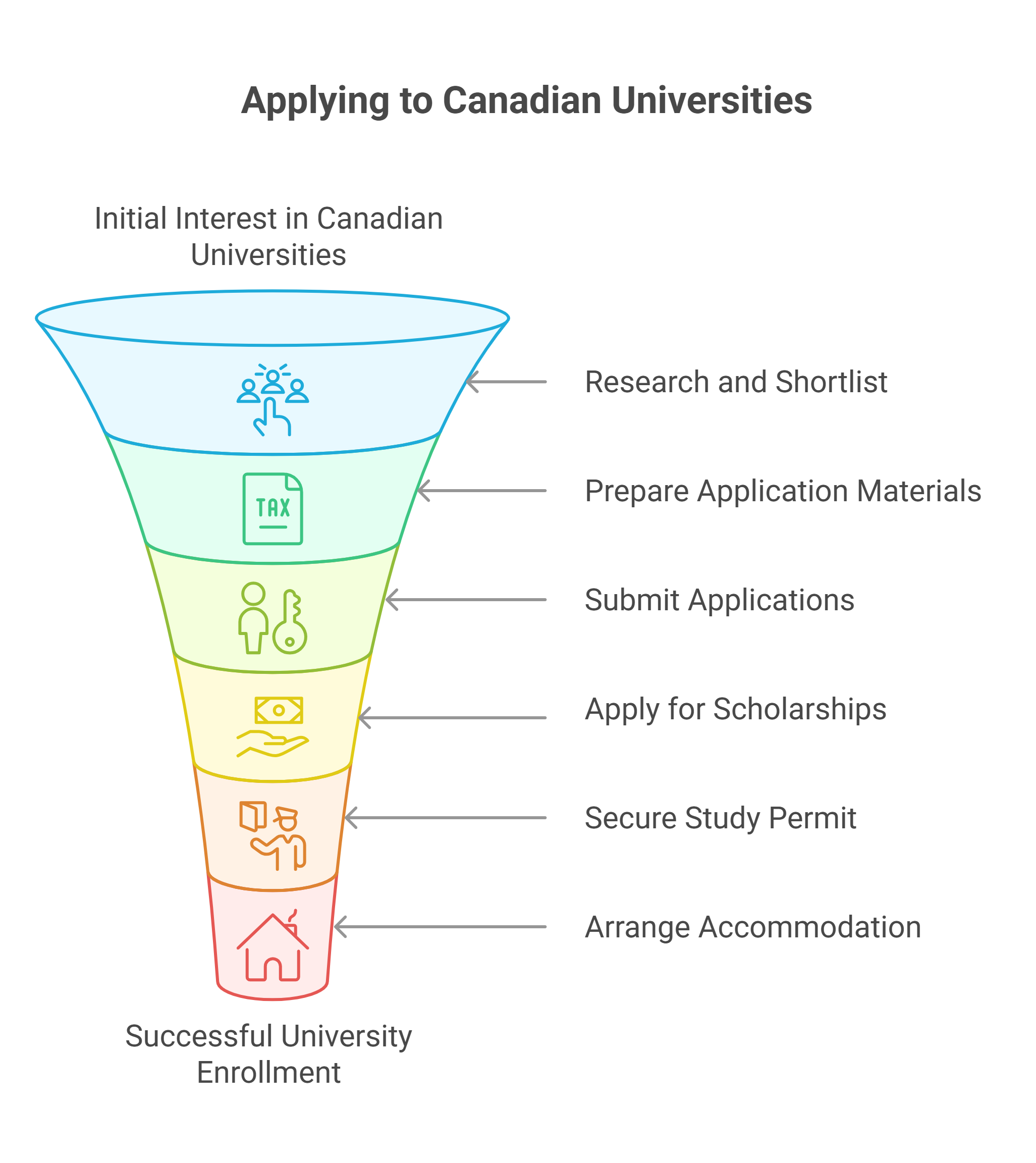
Step-by-Step Guide: How to Apply to Affordable Canadian Universities
Step 1: Research and Shortlist
Timeline: 12-18 months before intended start date
- Identify Your Budget: Calculate total available funds including tuition, living expenses, and emergency funds
- Choose Programs: Research programs offered by affordable universities in your field of interest
- Compare Costs: Use university websites to compare tuition fees, living costs, and available scholarships
- Check Requirements: Review admission requirements, language proficiency needs, and prerequisite courses
Step 2: Prepare Application Materials
Timeline: 8-12 months before start date
Required Documents:
- Academic transcripts (certified translations if needed)
- Language proficiency test scores (IELTS, TOEFL, or equivalent)
- Statement of purpose/personal statement
- Letters of recommendation (2-3 typically required)
- Resume/CV highlighting relevant experience
- Portfolio (for creative programs)
Financial Documentation:
- Bank statements showing sufficient funds
- Scholarship award letters (if applicable)
- Sponsor letters and financial guarantees
Step 3: Submit Applications
Timeline: 6-10 months before start date
Application Platforms:
- Ontario Universities: OUAC (Ontario Universities' Application Centre)
- British Columbia: Direct to universities
- Other Provinces: University-specific application systems
Key Deadlines:
- Fall Intake: January-March deadline
- Winter Intake: September-October deadline
- Summer Intake: January-February deadline
Step 4: Apply for Scholarships
Timeline: Simultaneously with university applications
Types of Scholarships:
- Merit-based: Academic excellence scholarships
- Need-based: Financial aid for students with demonstrated need
- Program-specific: Scholarships for particular fields of study
- Geographic: Awards for students from specific regions
Step 5: Secure Study Permit
Timeline: 3-4 months after acceptance
Required for Study Permit:
- Letter of acceptance from designated learning institution
- Proof of financial support (CAD $10,000 + tuition fees)
- Language proficiency proof
- Medical examination (if required)
- Police clearance certificate
Processing Time: 4-12 weeks depending on country of residence
Step 6: Arrange Accommodation and Arrival
Timeline: 2-3 months before departure
Accommodation Options:
- On-campus residence: Apply early as spaces are limited
- Off-campus housing: Research neighbourhoods and transportation options
- Homestay programs: Cultural immersion with local families
- Shared apartments: Cost-effective option with other students
Conclusion
Canada offers exceptional opportunities for students seeking quality education at affordable prices. The key to success lies in thorough research, early application, and strategic planning. Whether you choose the coastal charm of Newfoundland or the prairie affordability of Saskatchewan, Canada's affordable universities provide pathways to academic excellence without overwhelming debt.
Remember that the most affordable option isn't always the cheapest upfront cost---consider factors like program quality, employment opportunities, scholarship availability, and long-term career prospects when making your decision.
Start your research early, explore scholarship opportunities, and don't hesitate to contact university admissions offices for specific information about costs and financial aid. Your investment in Canadian education opens doors to a world-class academic experience, valuable work opportunities, and potential pathways to permanent residence in one of the world's most welcoming countries.
Frequently Asked Questions
Q: Are there any completely free universities in Canada?
A: There is no university in Canada that does not charge a tuition fee. However, if students can manage to get a fully-funded scholarship, they can pursue their higher education without paying the tuition fee.
Q: Which provinces offer the lowest tuition fees?
A: Newfoundland and Labrador, New Brunswick, and Saskatchewan consistently offer the lowest tuition fees combined with affordable living costs.
Q: Can international students work whilst studying in Canada?
A: Yes, international students can work up to 20 hours per week during regular academic sessions and full-time during scheduled breaks.
Q: What's the average cost of living for students in Canada?
A: On average, living costs are around $15,000 per year for university students, though this varies significantly by location and lifestyle choices.