Envision these programmes as express routes leading from your current CV to your target job title. Unlike sprawling degree programmes that unfold over years with many peripheral requirements, bridge courses provide flexible, targeted, hands-on instruction focused on relevant skills for particular industries. Graduates emerge with real and relevant skills, plus newly earned credentials, ready for the next round of interviews in weeks rather than years.
Another unique benefit is the customisation inherent in superior quality bridge offerings. Every field has its unique set of valued skills, and courses tailor to those precise targets whilst respecting the skills and experiences you already possess. Whether learning clinical software for nurse leaders or fluent code for tech stack beginners, these programmes focus on desired outcomes rather than irrelevant credentials.
Understanding Bridge Course Essentials
What Distinguishes Bridge Courses from Other Course Types
Bridge courses take a fundamentally different approach compared to other academic programmes. Unlike traditional programmes, they don't dwell on academic gaps accompanying learners' current professional stage. Instead, they focus on real-world necessary skills. For instance, a nursing bridge course serves as a ramp helping both novice and experienced nurse's shift to their next professional stage.
Every learner, regardless of education level, has access to these pathways, often available even during work shifts. These commonly take less time than full undergraduate nursing courses to complete. This feature serves engagingly for employed adults whose tight work and family schedules provide no opportunity for full study courses, yet these adults require study to meet unmet professional expectations.
Tailored Customisation
Today's bridge programmes recognise that adult learners come to education with varying backgrounds, experiences, and learning differences. Successful programmes provide multiple delivery systems, including fully online, hybrid, and accelerated options fitting working professionals' schedules.
Customisation extends beyond timing. Many programmes begin with skills assessments identifying what you already know. This way, you can skip basic technique lectures and spend time on advanced applications from your first week. Outcomes like this reduce completion time whilst increasing material relevance.
Healthcare Bridge Courses: Advancing Your Medical Career
Nursing Bridge Programmes
Nursing bridge programmes facilitate transitions from paramedic and practical nursing to registered nursing, from bachelor's to master's degrees, and other progression steps between.
These programmes typically take 12-18 months, including practical coursework in analysis, pharmacology, and higher-level clinical reasoning. Expect to learn advanced assessment, comprehensive care planning, and basic RN leadership skills in foundation courses.
Registered nurses (RNs) often prefer flexible or fully remote learning options for Bachelor of Science in Nursing (BSN) degree attainment. Curriculum components include leadership, research, population-based medicine, and capstone subjects like evidence-based practice refinement.
RNs pursuing academic master's degrees in nursing science are prepared for new roles such as advanced practice nurse practitioners, clinical nurse specialists, and nursing educators through specially tailored, time-compressed BSN to master's programmes.
Healthcare Support Role Transitions
Medical assistant to nursing bridges take advantage of presented clinical experiences and direct patient contact, then enhance pharmacology and pathophysiology understanding for confident nursing care provision. These programmes strengthen assessment and decision-making skills, easing integration with RN workforce.
Paramedic to nursing bridges are designed for candidates with direct healthcare frontline experience. Frequently holding RN, LPN, CNA, or Paramedic licensure, candidates may utilise competencies for faster nursing process routes, acquiring requisite credentials and formal education.
Application Process
Step 1: Prerequisites Verification - Ensure current practice licence validity, GPA within programme range (2.5-3.0), and necessary science classes completed within five years.
Step 2: Submit Required Documentation - Gather official transcripts, current licence verification, employer references, and personal statements regarding career goals and programme pursuit reasons.
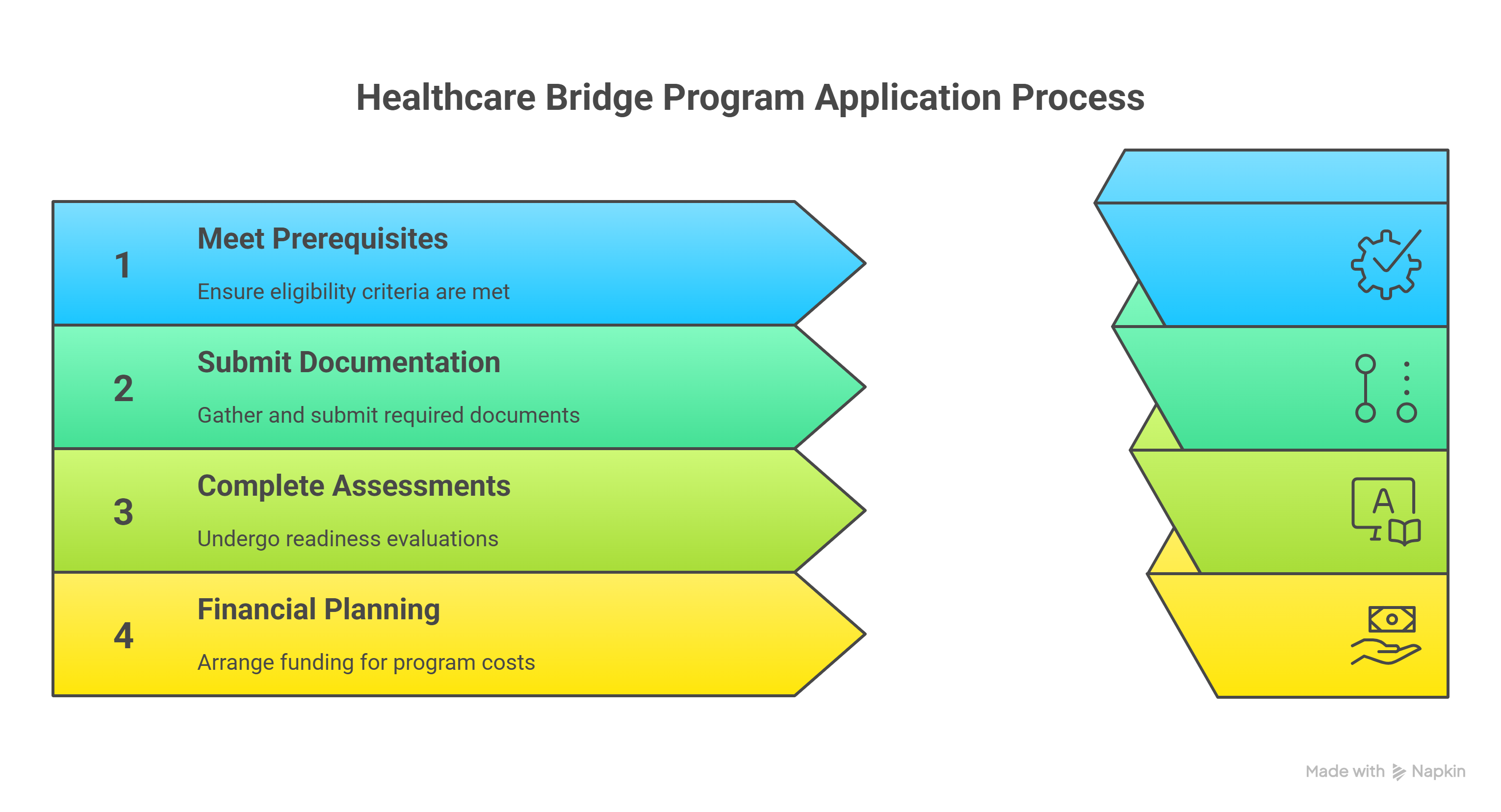
Step 3: Complete Assessment Requirements - Most programmes assess readiness through entrance tests (e.g., TEAS), skills demonstrations, or interviews.
Step 4: Financial Planning - Consider overall costs ranging from $15,000-$40,000 depending on institution and programme length. Explore employer-sponsored education, grants, and scholarships for healthcare professionals, federal financial aid, and tuition reimbursement.
Technology Bridge Courses: The Digital Economy
Software Development Bootcamps
Technology bridge courses rapidly fill career shift gaps in high-demand digital areas. Most in-demand are coding courses with accelerated programming, web design, and software engineering instruction.
Full Stack Development Tracks: HTML, CSS, and JavaScript on client-side; databases, server-side scripting, and RESTful API design on server-side.
Data Science Preparation Units: For analysts, engineers, and evaluators, focusing on Python and R scripting, supervised learning models, and dashboard creation with story-level insights.
Cybersecurity Career Fast Tracks: Anti-fraud and risk professions are rapidly advancing, likely increasing thirty-one percent by decade's end. These tracks prepare students for positions like SCADA security operations centre analysts, ethical hackers, or regulatory compliance coordinators.
Technology Transition Programme Selection Guidelines
When preparing curricula, ensure inclusion of current job market options like Docker, React, and Terraform. Focus on bootcamps or micro-credential programmes with long-term employer relationships, as these sponsors provide guest lectures, mock interviews, and specialised skill training.
Select career paths focusing on completing one to three projects for GitHub portfolios or hiring manager case studies.
Business and Finance Transition Tracks
Management Essentials for Technical Professionals
Specialised condensed management essentials units prepare you for rigorous constraints accompanying leadership titles without spending three to five years in academic institutions.
Mid-career practitioners appreciate confidence from sharpened strategic orientation, organisational influence, and increased financial acumen seamlessly integrated in cohorts designed to foster deeper Command and Control mastery for C-suite roles.
Project Management Certification Pathways: Each curriculum combines Agile, PMP, PRINCE2 with practical approaches, empowering learners with core competencies to manage and lead projects in any field.
Finance Sector Bridges
CFA Pathway Programmes: Tailored for those pivoting to investment analysis and portfolio management, delivering in-depth Chartered Financial Analyst credential preparation.
Comprehensive Financial Planning Courses: Professionals from diverse disciplines train as financial advisors, mastering investment strategy, estate structuring, and compliance standards in tight, practical curricula.
Education Sector Pathways
Expedited Alternative Teaching Certification: Credentials in under one year for career changers and mid-career professionals with bachelor's degrees in non-education fields, with classroom time and mentorship built in.
TESOL/TEFL Professional Certification: Accelerate global teaching opportunities with immersive, blended certification pairing classroom methodology with regional cultural insight.
Engineering and Technical Field Bridges
Engineering Technology to Engineering Pathways: These degrees leverage prior technician expertise, shortening time-to-degree through targeted advanced mathematics and core engineering principles.
Career Change Programmes in Engineering: Tailored tracks allow high-achieving, physics-based majors to enter accelerated master's through intensive preparatory curricula, elevating STEM bachelor degree holders to engineering competencies in one-to-two years.
"Bridge programmes represent professional education's future," says Dr. Michael Patterson, Continuing Education Director at a major state university. "They understand adult learners come with varied experiences and precise ambitions. Most effective programmes outline direct pathways honouring what students know whilst quickly filling gaps needed for next steps."
Conclusion
Bridge programmes represent education's future, providing precise pathways from current positions to career goals without years-long commitments. Success depends on careful programme selection complementing current skills, desired goals, and preferred learning styles. Don't hesitate to contact programme administrators and alumni for guidance on educational investments.
The certain thing in life is accepting new challenges for personal and professional growth. These valuable courses minimise time whilst teaching needed skills and certifications, helping configure plans ensuring career advancement with every new credit.
Frequently Asked Questions
How do bridge courses differ from traditional degree programmes?
Bridge courses are purposeful, accelerated experiences focusing on specific skills gaps between current qualifications and professional goals, providing immediately actionable skills within months.
Do employers accept bridge course certificates?
Yes, especially from reputable programmes. Many employers prefer candidates with bridge course certifications due to recent, relevant skills.
Can students work whilst enrolled in bridge courses?
Yes. Most programmes offer flexible scheduling including evenings and weekends. Specialised programmes for shift workers, particularly in medical fields, are available.
How much do bridge courses cost?
Costs vary by field and duration. Technology bootcamps range $10,000-$20,000, healthcare courses $15,000-$40,000, and business courses $5,000-$25,000.
Student Testimonials
Sarah Chen, a former marketing manager who completed a data science bridge, explains: "The programme was precisely what I hoped for. It leveraged my marketing analysis background and layered on technical skill sets data science demands. I graduated in six months and secured a new data analyst job with a 40% salary jump within weeks."
James Rodriguez moved from ambulance to bedside through a paramedic-to-RN bridge: "The programme acknowledged my clinical hours and focused on what I hadn't mastered. This saved two calendar years compared to typical ADN routes, and I maintained part-time paramedic hours throughout."