Getting to Know the CSU System
The California State University system spans the entire state, from Cal Poly San Luis Obispo up north to campuses down in San Diego. With 23 campuses total, each one has its own personality while maintaining the same academic standards across the board. What I love about the CSU system is how it manages to offer both quality education and reasonable transfer options no matter which campus you choose.
The diversity here is incredible. You have got everything from small college towns to major metropolitan areas. Cal Poly Pomona has built a solid reputation in engineering, San Diego State is known for its business programs and innovative approach, and CSU Long Beach has become a hub for liberal arts students who want a well-rounded education. Whether you're planning to be an architect, work in finance, or curate art exhibitions, there's probably a CSU campus that fits what you're looking for.
Here's what really impressed me: the system offers over 3,800 undergraduate and graduate programs. Most focus on bachelor's and master's degrees, though you can find some doctoral programs too, especially in business, engineering, education, health sciences, and liberal arts. The whole system seems designed to feed California's economy with skilled professionals - from tech workers in Silicon Valley to teachers in local schools to healthcare workers in hospitals statewide.
The job placement rates are pretty solid too. Recent data shows that most bachelor's degree graduates land their first professional job within six months. This probably has a lot to do with CSU's focus on hands-on learning. Instead of just sitting in lecture halls, students work on real projects that mirror what they'll actually do in their careers.
CSU Admissions: What You Need to Know
Requirements for High School Students
Getting into a CSU campus isn't terribly complicated, but you do need to meet some basic requirements. The system looks at your whole application - grades, coursework, activities, and test scores if you submit them.
Core Classes You'll Need:
- 4 years of college-prep English
- 3 years of math (including Algebra II)
- 2 years of science (one must be a lab course)
- 3 years of social studies/history
- 2 years of the same foreign language
- 1 year of visual or performing arts
- 1 year of college prep electives
GPA Requirements: California residents need at least a 2.0 GPA, but let's be honest - the popular campuses want much higher. San Diego State and Cal Poly SLO regularly see incoming freshmen with GPAs above 3.7. If you're aiming for these competitive campuses, you'll want to shoot higher than the minimum.
Test Scores: Optional but Helpful
Here's some good news: CSU doesn't require SAT or ACT scores for admission anymore. They might use your scores for class placement once you're admitted, but they won't keep you out if you don't submit them. The reasoning makes sense - high school GPA tends to be a better predictor of college success than standardized test scores. That said, if you crushed the SAT or ACT, go ahead and submit those scores.
How to Apply
Important Dates to Remember
- October 1-December 1: Regular fall application period
- June 1-June 30: Spring applications (limited programs only)
- August 1-August 31: Summer applications (select campuses)
The application window opens every October for the following fall. If you're a junior in high school, now's the time to start planning so you don't miss any deadlines.
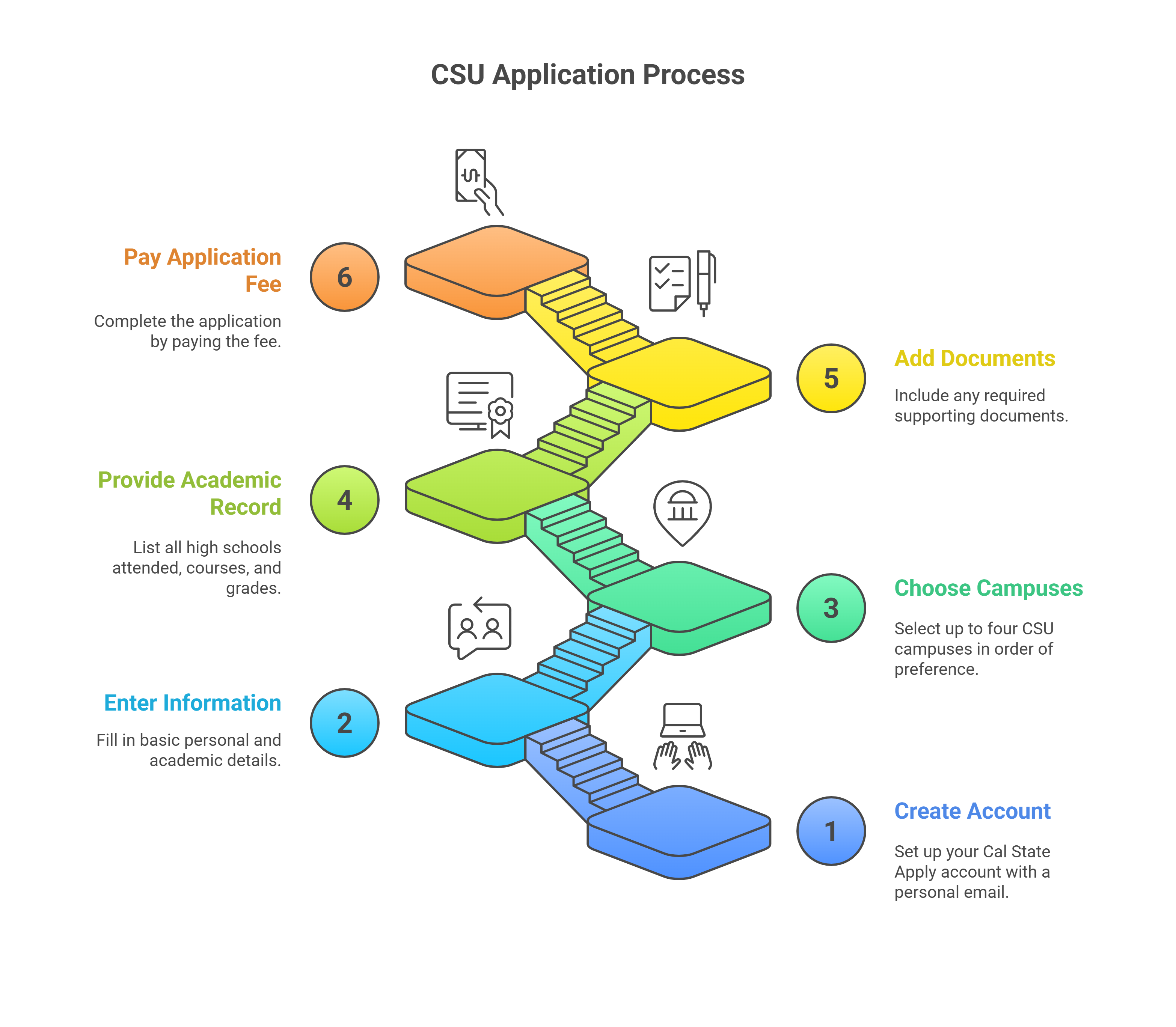
Step-by-Step Application Process
Step 1: Create your Cal State Apply account at the official portal. Use an email you actually check regularly.
Step 2: Fill in your personal and academic information. Pretty straightforward - name, address, phone number, and your high school coursework.
Step 3: Pick your campuses and majors. You can choose up to four CSU campuses and rank them by preference. Don't forget to select your intended major for each campus.
Step 4: Enter your academic history. List every high school you've attended, all your courses, and your grades.
Step 5: Upload any additional documents if required. Most programs don't need extra materials, but some might ask for essays or portfolios.
Step 6: Pay the application fees. It's $70 per campus, though fee waivers are available if you qualify financially.
Transfer Students: Your Path In
Transfer students have a slightly different process with a few extra requirements:
What You'll Need:
- At least 60 transferable semester units (or 90 quarter units)
- Minimum 2.0 GPA in all transferable coursework
- Completion of the "Golden Four" general education areas
If you're coming from a California community college, you're in luck. The Associate Degree for Transfer (ADT) guarantees you a spot somewhere in the CSU system, though you might not get your first choice of campus or major if it's impacted.
Money Matters: Costs and Financial Aid
2024-25 Costs
California Residents:
- Tuition and fees: $5,742/year
- Campus-specific fees: $1,000-$3,000 (varies by location)
- Room and board: $12,000-$18,000
- Books and supplies: $1,200-$1,800
- Total estimated cost: $20,000-$28,500/year
Out-of-State Students:
- Add $396 per unit (about $11,880 for a full year)
- Total estimated cost: $31,880-$40,380/year
Financial Aid Options
More than 60% of CSU students receive some form of financial aid, which definitely helps make college more affordable. Here are the main programs to look into:
- Cal Grant A and B: California state grants
- Federal Pell Grants: Need-based federal funding
- CSU scholarships: Merit-based aid from individual campuses
- Federal Work-Study: Part-time campus jobs
- Middle-Class Scholarship: Help for moderate-income families
Choosing the Right CSU Campus
Consider Your Major
Different campuses have different strengths. Engineering students often gravitate toward Cal Poly, while business majors frequently choose San Diego State or CSU Fullerton. Do some research on which schools excel in your field.
Think About Size and Atmosphere
CSU campuses vary dramatically in size. Some enroll under 10,000 students, while others have over 40,000. Smaller campuses offer a more intimate experience, while larger ones provide more resources and student organizations.
Location and Cost of Living
Consider how far you want to be from home, what kind of climate you prefer, and local living costs. Coastal campuses generally have higher rent than inland locations.
Campus Spotlights
San Diego State University: Known for strong business and engineering programs with an active campus life. Admissions are competitive, but graduates benefit from an extensive alumni network.
Cal Poly San Luis Obispo: The most selective CSU campus, famous for engineering and agriculture programs with a "learn by doing" philosophy.
CSU Long Beach: Excellent liberal arts, business, and health science programs with a diverse, engaged student body.
Fresno State: Comprehensive programs at reasonable costs, with particular strengths in agriculture, business, and education.
Final Thoughts
The CSU system is designed to help students succeed academically while preparing them for real careers. By figuring out your priorities early and staying organized with applications, you can find a campus that fits your goals and budget.
Employers throughout California actively recruit CSU graduates, recognizing the practical skills and real-world experience these programs provide. Whether you're drawn to tech in Silicon Valley, entertainment in LA, or agriculture in the Central Valley, a CSU degree can be your stepping stone to a meaningful career.
The best part? The system keeps education accessible and affordable while maintaining quality. It's a smart investment in your future that won't leave you drowning in debt.
Frequently Asked Questions
Can I change my major after being admitted?
Yes, most campuses allow major changes after admission, as long as you make the switch relatively quickly. Some popular or impacted majors have stricter requirements, so contact your campus academic advising center as soon as you're considering a change.
How does CSU compare to UC schools?
CSU focuses more on undergraduate teaching and career preparation, while UC emphasizes research and graduate education. Many students find CSU to be more affordable and practical, with smaller class sizes in upper-division courses.
Can I earn my degree completely online?
Yes, several CSU campuses now offer fully online bachelor's and master's degree programs.